Women’s rugby benefits from lower tackle height, study shows
12 May 2025Lowering the legal tackle height in women’s rugby is proving effective in reducing head contacts between players, a world-first study suggests.


Lowering the legal tackle height in women’s rugby is proving effective in reducing head contacts between players, a world-first study suggests.
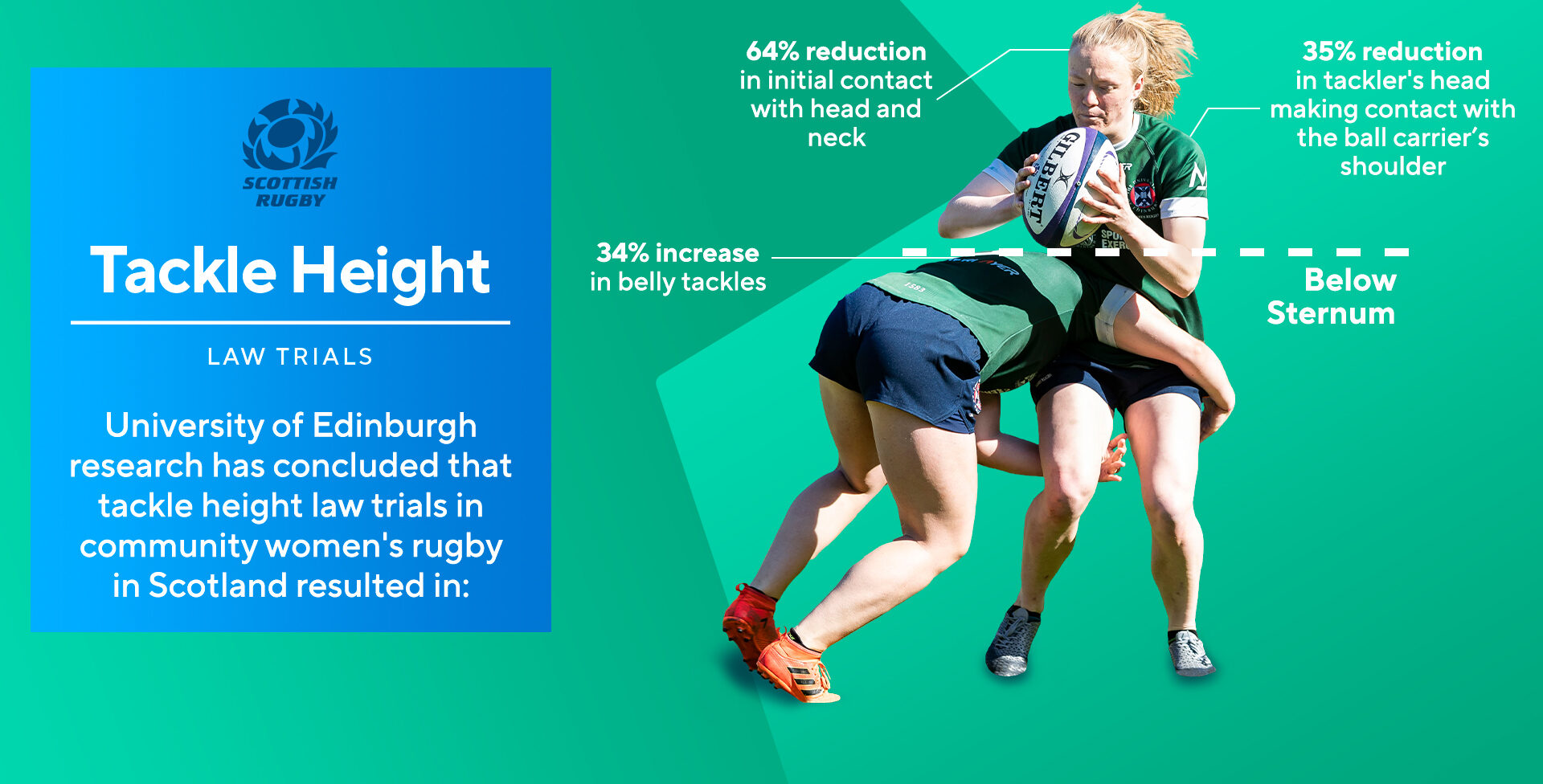
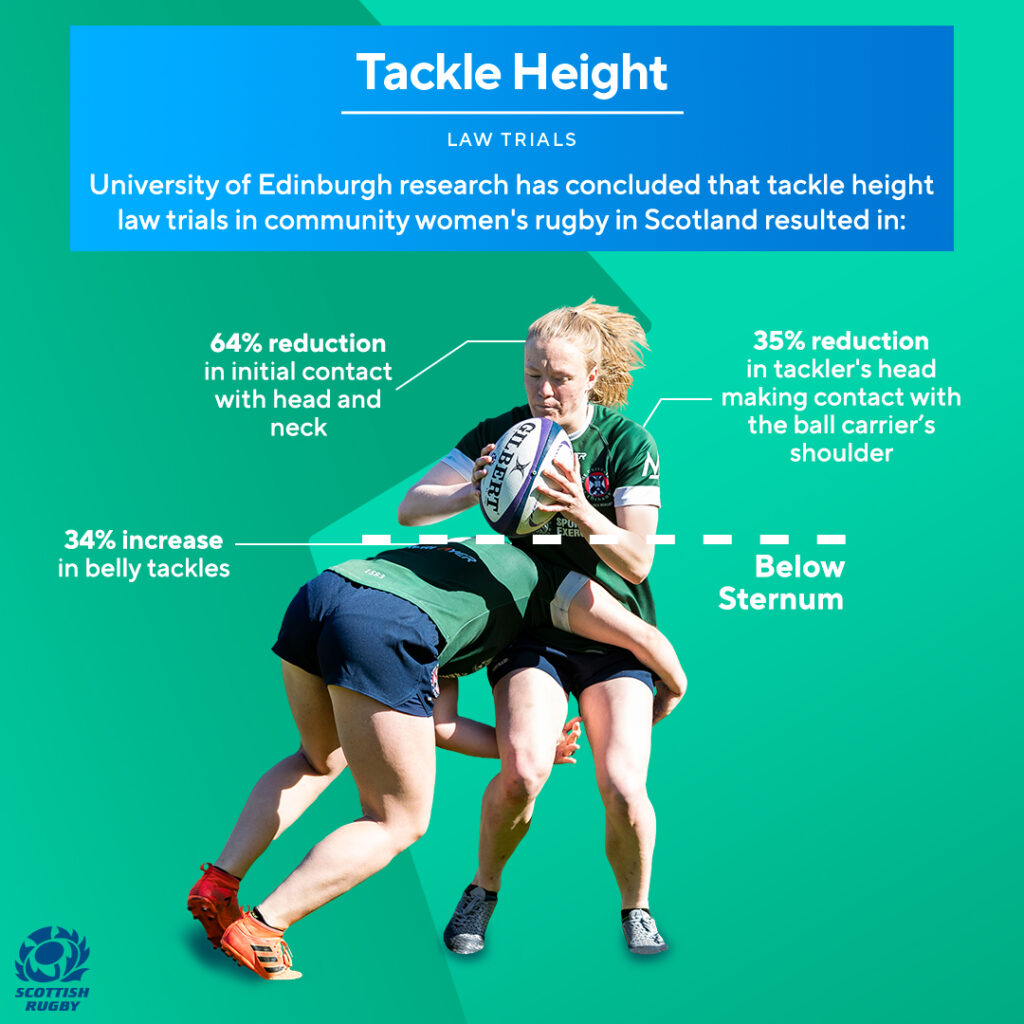
Changes to the tackle height law in women’s community rugby in Scotland is linked to reductions in head-to-head and head-to shoulder contacts, the study found.
A study compared more than 11,000 tackles between the 2022/23 season, before the reduced tackle height law was trialed and the 2023/24 season when it was introduced.
Experts found 21% fewer upright tackles and a 34% increase in tacklers entering the tackle bent at the waist, the recommended technique to reduce contact to the high-risk areas of the head and shoulders.
In collaboration with Scottish Rugby and World Rugby, researchers at the University of Edinburgh used video analysis to study the impact of the lowered tackle height law which World Rugby, the sport’s governing body, introduced for community rugby in an attempt to improve safety for players.
The research found a 64% reduction in tacklers making initial contact with the ball carrier’s head and neck – one of the primary causes of sports related concussion.
Lowering the tackle height was also associated with a 17% reduction in the rate of head-to-head and a 35% reduction in head-to-shoulder contacts for the tackler, the study found.
The study, which is the first to evaluate the lowered tackle height law in women’s community rugby, shows a positive change in player behaviour, researchers say.
The findings can inform future injury prevention initiatives in women’s community rugby in Scotland and beyond, they add.
World Rugby recommended an opt-in international trial of lowering the tackle height from the shoulder to below the sternum as part of a drive to reduce the risk of head-on-head contact and concussion in rugby union games.
The trial was adopted by Scottish Rugby for the 2023/2024 season alongside other nations including Australia, England, France, Ireland, Italy, Japan New Zealand, South Africa and Wales.
Researchers at Moray House School of Education and Sport analysed video footage and injury data from 34 Scottish community women’s rugby matches from the top-level Premiership to the third-tier regional leagues.
The analysis used footage from Scottish Rugby which recorded players’ activity including tackle type, body position, contact point and head contact.
Points of contact between players alongside match events and tackle characteristics were coded according to guidelines developed in collaboration with World Rugby and the University of Cape Town.
They also discovered a 19% reduction in contacts above the sternum – known as the red zone – between the tackler and the ball-carrier. There was a 29% reduction in head-to-head proximity for the tackler, alongside a 33% reduction in head-to-head proximity and a 48% reduction in head-to-shoulder contact for the ball-carrier.
Positively, there were no increases in the rate of the tacklers head making contact with the ball carriers’ knee or hip, which has previously been associated with an increased risk of concussion.
Sanctions – including penalties, advantages and yellow cards related to high tackles increased significantly from three to eight in the 2023/2024 season. The number of tackles decreased significantly, but there was no significant change to the rate of other game player metrics.
The rate of concussions and injuries when comparing the 2022/23 (pre-trial) and 2023/24 (trial) seasons did not change significantly but the number of reported injuries overall was very low and may have impacted these findings.
Lead author, Hannah Walton, of the University of Edinburgh’s Moray House School of Education and Sport, said: “Our findings show reducing the maximum legal tackle height in Scottish women’s community rugby has resulted in a positive change in player behaviour, alongside reductions in tackler and ball-carrier head contact and head proximity to the oppositions head and shoulder. Continued collection of robust tackle and injury data is key to further understanding the effect of the law change.”
Researchers say the study provides valuable data on the impact of the tackle height change in women’s rugby and further studies could help understand the effect of the change on injury and concussion prevention.
Dr Debbie Palmer, of the Institute for Sport, Physical Education and Health Sciences at the Moray House School of Education and Sport, and co-Director for the UK Collaborating Centre on Injury and Illness Prevention in Sport IOC Research Centre, said: “This is the first study evaluating the impact of a lowered tackle height in community women’s rugby and it is good to see, similar to the men’s community study, that initial results are encouraging.
“While injury and concussion numbers were low, gathering robust community wide injury surveillance data may help us make more meaningful conclusions. Overall, reductions in head proximity and contact between players is likely to have been beneficial in potentially reducing these concussive events.”
The study builds on the findings of a recent study to assess the impact of the tackle height law change on Scottish men’s community rugby. Evaluations are underway to assess the change on youth community rugby in Scotland.
Scottish Rugby Head of Regional Pathways and Game Development, Neil Graham said: “We look forward to continuing this partnership with University of Edinburgh as we continue to look at ways to evolve the game, keeping player welfare at the centre of the conversation.
“We also look forward to the third and final study on the youth game being released in the near future.”
The study is published in BMJ Open Sport and Exercise Medicine.
The study is part of an international project led by World Rugby to assess the effects of lowering the tackle height in 11 countries including Australia, England, France, Ireland, Italy, Japan, New Zealand, Scotland, South Africa and Wales.
An international team of experts contributed to the study including researchers from the universities of Cape Town and Stellenbosch in South Africa, Calgary in Canada and Leeds Beckett.
The work was funded by World Rugby and Scottish Rugby.
 Cup & Competitions
Merchiston and Edinburgh Academy Renew Rugby’s Oldest School Rivalry
Thu 24 Sep 2026
Cup & Competitions
Merchiston and Edinburgh Academy Renew Rugby’s Oldest School Rivalry
Thu 24 Sep 2026
 Cup & Competitions
Competitions continue across the country
Tue 22 Sep 2026
Cup & Competitions
Competitions continue across the country
Tue 22 Sep 2026
 Player Pathway
Girls’ Inter-District teams set for first outing of the season
Fri 18 Sep 2026
Player Pathway
Girls’ Inter-District teams set for first outing of the season
Fri 18 Sep 2026
 Cup & Competitions
Ollie Smith Looks Ahead to Scottish Rugby Match of the Week Between Marr Rugby and Ayr RFC
Thu 17 Sep 2026
Cup & Competitions
Ollie Smith Looks Ahead to Scottish Rugby Match of the Week Between Marr Rugby and Ayr RFC
Thu 17 Sep 2026
 Cup & Competitions
Competitions continue to gather pace as another weekend unfolds
Tue 15 Sep 2026
Cup & Competitions
Competitions continue to gather pace as another weekend unfolds
Tue 15 Sep 2026
 Area Development
Dave Rollo lauded as Howe of Fife names Duffus Park stand in his honour
Fri 11 Sep 2026
Area Development
Dave Rollo lauded as Howe of Fife names Duffus Park stand in his honour
Fri 11 Sep 2026
 Cup & Competitions
Erskine Stewart Melville v Stirling County headlines this weekend’s action
Thu 10 Sep 2026
Cup & Competitions
Erskine Stewart Melville v Stirling County headlines this weekend’s action
Thu 10 Sep 2026
 Area Development
Match Official Conference Gets New Season Underway
Tue 8 Sep 2026
Area Development
Match Official Conference Gets New Season Underway
Tue 8 Sep 2026
 Cup & Competitions
Currie hold off Heriot’s in Edinburgh Derby as busy club rugby weekend unfolds
Tue 8 Sep 2026
Cup & Competitions
Currie hold off Heriot’s in Edinburgh Derby as busy club rugby weekend unfolds
Tue 8 Sep 2026
 Cup & Competitions
Derby Day, Friday Night Lights and Premiership Action Await
Thu 3 Sep 2026
Cup & Competitions
Derby Day, Friday Night Lights and Premiership Action Await
Thu 3 Sep 2026
 Cup & Competitions
All eyes on the opening weekend of the Arnold Clark Women’s Premiership
Tue 1 Sep 2026
Cup & Competitions
All eyes on the opening weekend of the Arnold Clark Women’s Premiership
Tue 1 Sep 2026
 Cup & Competitions
Opening Weekend Delivers as 2026/27 Season Gets Underway
Mon 31 Aug 2026
Cup & Competitions
Opening Weekend Delivers as 2026/27 Season Gets Underway
Mon 31 Aug 2026
 Area Development
A tale of two Gregors
Thu 27 Aug 2026
Area Development
A tale of two Gregors
Thu 27 Aug 2026
 Cup & Competitions
Boys’ U18 Open Competition Returns with Friday Night Match of the Week
Thu 27 Aug 2026
Cup & Competitions
Boys’ U18 Open Competition Returns with Friday Night Match of the Week
Thu 27 Aug 2026
 Area Development
Caithness RFC Granted £10K Funding From Women & Girls’ Rugby Award
Wed 26 Aug 2026
Area Development
Caithness RFC Granted £10K Funding From Women & Girls’ Rugby Award
Wed 26 Aug 2026
 Cup & Competitions
All Set for Kick-Off as Arnold Clark Men’s Premiership Returns
Tue 25 Aug 2026
Cup & Competitions
All Set for Kick-Off as Arnold Clark Men’s Premiership Returns
Tue 25 Aug 2026
 Player Pathway
Under-18s in action during Stirling training camp
Fri 7 Aug 2026
Player Pathway
Under-18s in action during Stirling training camp
Fri 7 Aug 2026
 Player Pathway
Riddell names Scotland Women U18s squad for Summer Series
Wed 5 Aug 2026
Player Pathway
Riddell names Scotland Women U18s squad for Summer Series
Wed 5 Aug 2026
 Area Development
Gregor Townsend to headline summer Pro Coach Masterclass series
Mon 13 Jul 2026
Area Development
Gregor Townsend to headline summer Pro Coach Masterclass series
Mon 13 Jul 2026
 Scotland Women U20
Megan Hyland embraces National Academy opportunity
Thu 9 Jul 2026
Scotland Women U20
Megan Hyland embraces National Academy opportunity
Thu 9 Jul 2026